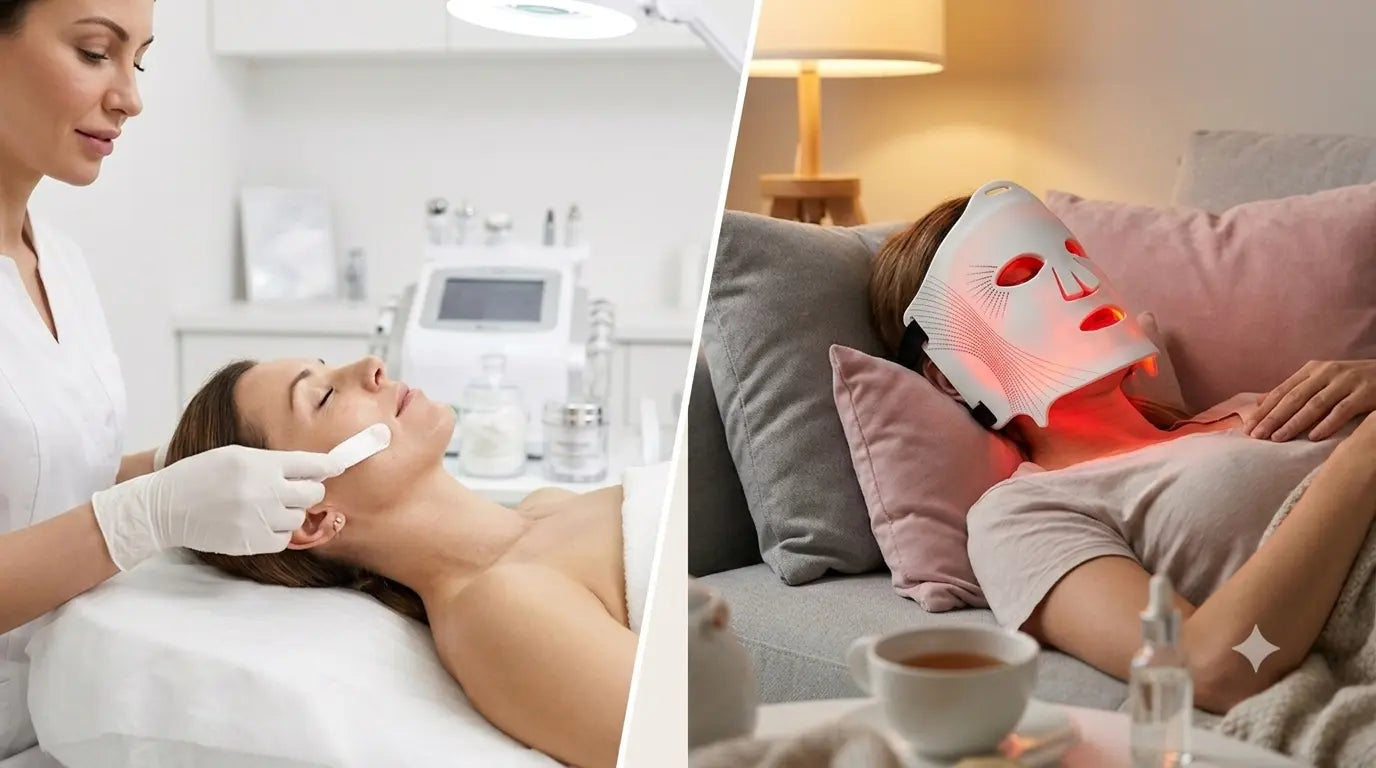
A quality at-home LED face mask costs roughly the same as two to four professional LED facial sessions. That comparison alone makes some people hesitate — until you account for what happens after the purchase. A clinic session ends when you walk out the door. An at-home device doesn't. This article works through the actual numbers, including the scenarios where clinic treatment genuinely remains the better choice, so you can make the comparison based on your own situation rather than a marketing claim.
What clinic LED therapy actually costs in 2026
Professional LED facial pricing in 2026 spans a wide range depending on the panel quality and clinic positioning. In the US, standalone sessions run $75–$280, with medical-grade panels at boutique medspas and dermatology clinics sitting toward the higher end. Package pricing for six sessions typically costs $400–$1,300. In the UK, sessions outside major cities run £35–£90, while premium London clinics can reach £150 for targeted facial treatments — though bundles often offer a 10–30% discount for upfront commitment.
The number that matters most, however, isn't the per-session price — it's the course length. Published clinical protocols for visible anti-aging results require a minimum of 8–12 sessions. That means a single course of treatment, before any maintenance sessions, runs $600–$2,000+ in the US and a comparable range in the UK. And once that course ends, the results require ongoing maintenance to sustain — which means the cost doesn't stop at the course price.
What an at-home device actually costs
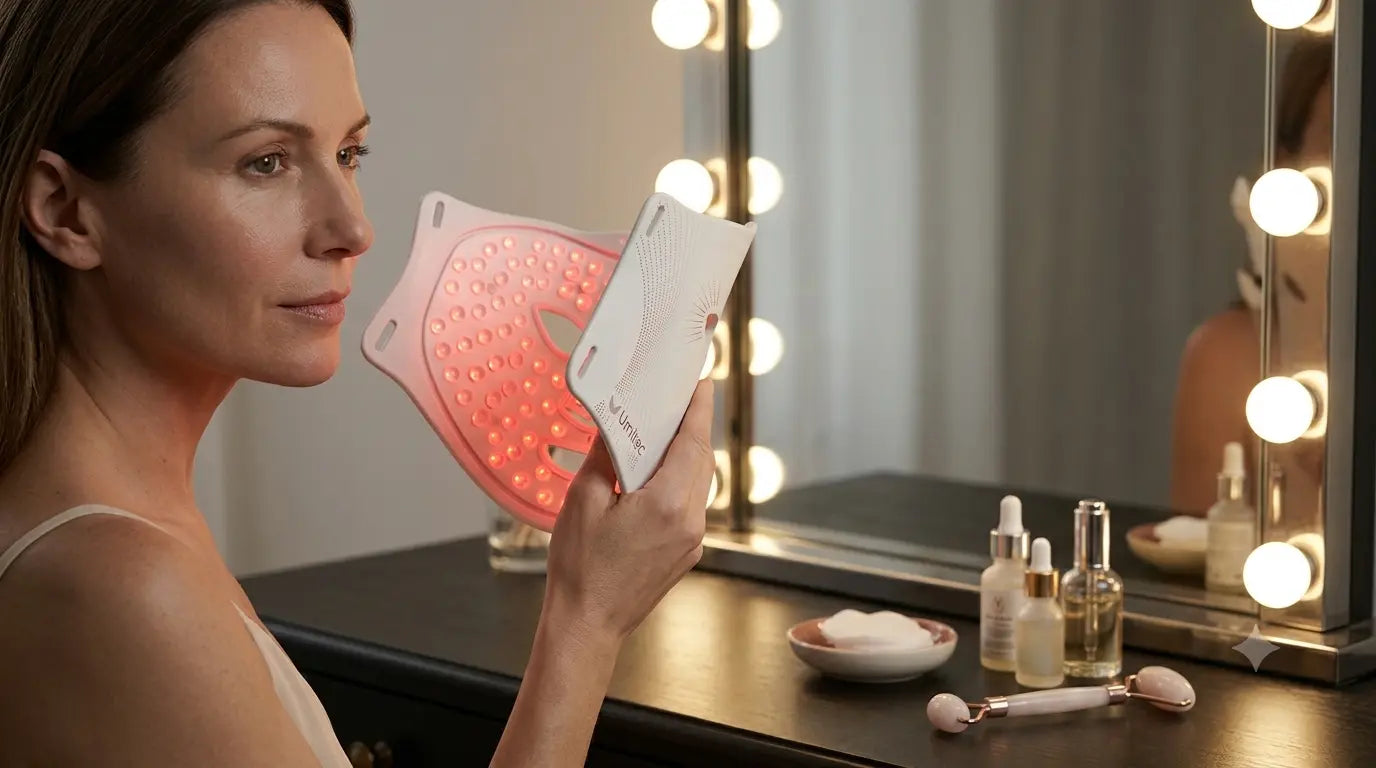
A quality at-home LED face mask with verified wavelengths and adequate irradiance costs $100–$350 as a one-time purchase. Devices priced under $100 are generally low-irradiance and unlikely to produce meaningful results within a standard treatment timeline — so the comparison here assumes a properly specified device, not the cheapest option on the market. After the purchase, the marginal cost per session is zero. No booking, no travel, no recurring fee, and no limit on how often you use it beyond the device's recommended protocol.
The break-even calculation
Take a quality at-home device priced at $209 — the Umitec LED Therapy Face Mask Series 3's price point — and compare it against an average clinic session price of $100 (a reasonable mid-range figure across both markets). Here's where the break-even point falls:
Cost per session over time
The break-even calculation tells only part of the story. The real difference becomes clear when you look at cost-per-session over realistic usage timelines — assuming a clinic routine of two sessions per month, and an at-home routine of three sessions per week.
| Timeline | Clinic route | At-home route |
|---|---|---|
| Annual cost | $2,400 (2 sessions/month at $100) | $209 one-time |
| Sessions per year | 24 | ~156 (3x/week) |
| Cost per session — Year 1 | $100 | $1.34 |
| Cost per session — Year 2 (cumulative) | $100 | $0.67 |
| Cost per session — Year 5 (cumulative) | $100 | $0.27 |
| Total cost — 5 years | $12,000 | $209 |
The clinic's cost-per-session never changes — it's $100 in year one and $100 in year five. The at-home device's cost-per-session approaches zero the longer it's used. This is the core mathematical difference: clinic treatment is a recurring expense with no ceiling, while an at-home device is a fixed cost that depreciates toward negligible over time.
The frequency factor — what the numbers don't show
The financial comparison alone actually understates the real-world difference, because it assumes both routes deliver the same results at the same pace — and they don't. Clinic visits are typically scheduled monthly or twice-monthly, constrained by cost, booking availability, and travel time. At-home devices enable three to five sessions per week, building cumulative light exposure significantly faster. The 8–12 week timelines cited in published LED research generally assume this kind of consistent, high-frequency use — which is genuinely difficult to sustain through clinic visits alone, both financially and logistically.
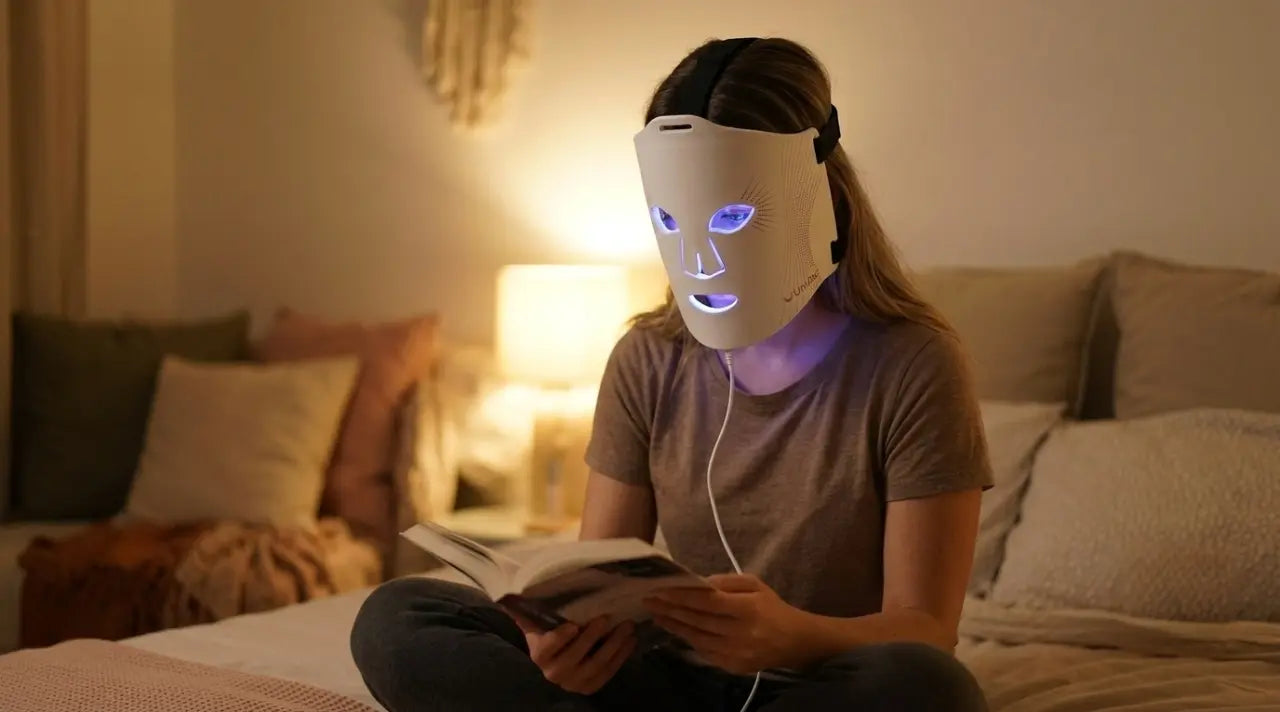
There's also the time cost: no commute, no appointment booking, no waiting room. A 10-minute session that happens while reading or watching something is a fundamentally lower-friction habit than a scheduled clinic visit — and habit sustainability is what determines whether a skincare routine produces results at all.
When clinic sessions still make sense
This comparison isn't a blanket case against professional treatment. Clinic sessions make genuine sense for a few scenarios: trying LED therapy before committing to a purchase, wanting expert guidance and a professional skin assessment, addressing severe concerns that may benefit from higher-output medical-grade panels, or simply preferring occasional treatments where building a consistent routine isn't the goal. For someone who wants one or two sessions a year as part of a broader aesthetic plan, the at-home math above doesn't apply in the same way — the value of an at-home device comes from frequency and consistency, and if that isn't the intended use case, the calculation changes.
Reducing the risk of the upfront cost
The one genuine downside of the at-home route is that the cost is paid upfront, before you know whether the device will fit your routine. The Umitec LED Therapy Face Mask Series 3 addresses this directly with a 30-day risk-free return window and a 2-year warranty covering free replacement for damage — both of which function as risk mitigation on the purchase decision, not as a reason to buy on their own. If the device doesn't become part of your routine within the first month, the financial exposure is limited; if it does, the 2-year warranty protects the investment over the timeline where the cost-per-session math becomes most favorable.
For anyone planning to use LED therapy as an ongoing part of their skincare routine — the frequency and consistency that published protocols are built around — the financial case for at-home ownership is straightforward within the first few months, not a long-term bet. A device like the Umitec Series 3, at $209 with four wavelengths covering the protocols typically offered across separate clinic treatments (red, near-infrared, yellow, and blue), delivers the cost-per-session figures above while remaining usable for years. The numbers don't require much interpretation — they just require comparing the right timeline.
Ready to start? Explore the Umitec LED Therapy Face Mask Series 3 →

发表评论
所有评论在发布前都会经过审核。
此站点受 hCaptcha 保护,并且 hCaptcha 隐私政策和服务条款适用。