




The question arrived in my inbox twice in one week, worded almost the same way both times: "I've been doing blue light on my whole face every night for a month. Am I giving myself melasma?"
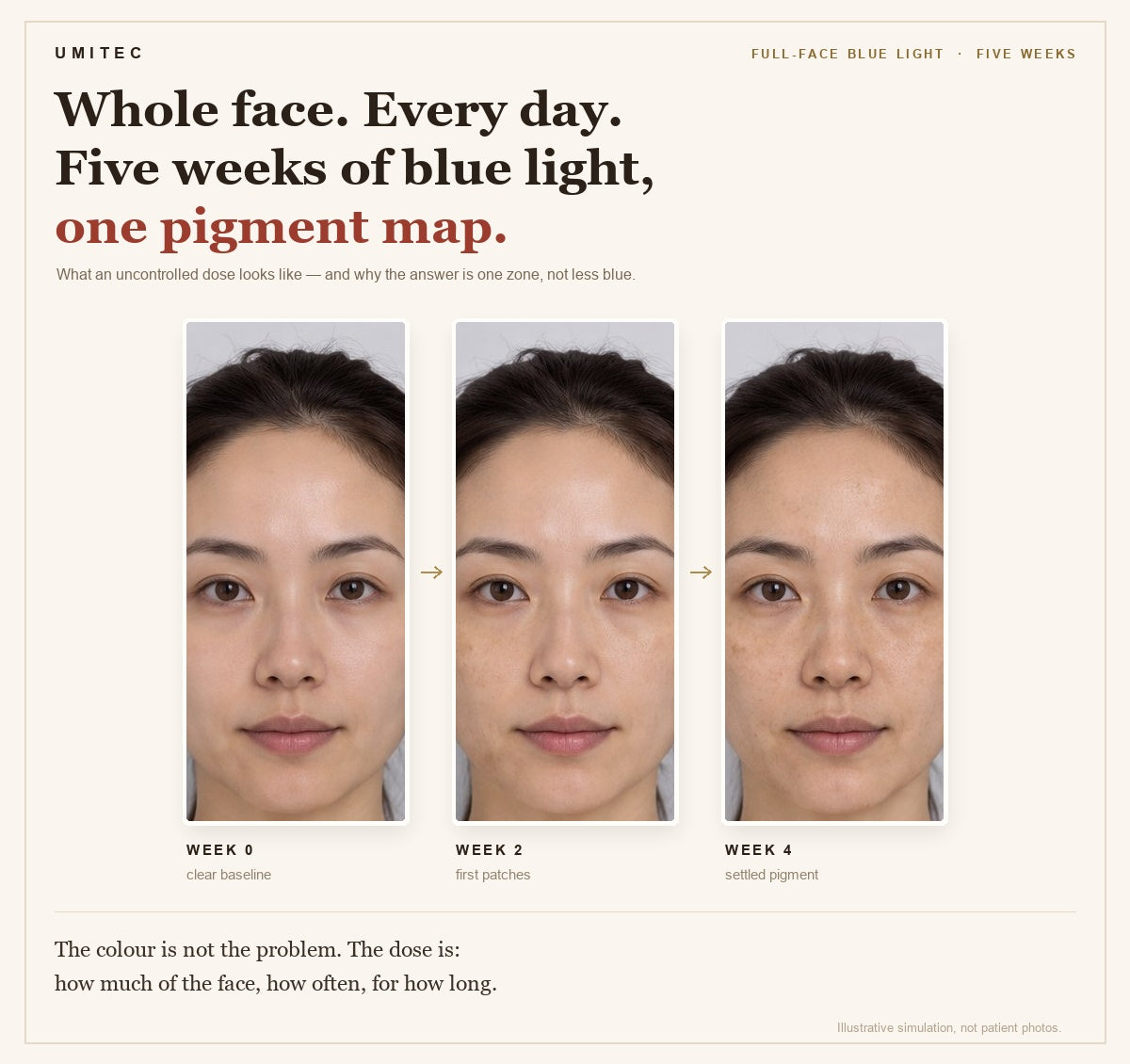
I didn't want to answer with a shrug. So I built the picture instead — the full five weeks, one session a day, the whole face lit, nothing but blue. Week 0 through Week 4, staged like a lab series.
It's an AI illustration, not a patient record — but the pattern it shows is the one worth understanding before you buy anything: pigment doesn't arrive because blue is blue. It arrives on skin that never had a spot — because the light went everywhere.
That's the whole argument, and it's the reason our own mask is built around zones instead of a blue wash: light the zone that's breaking out, leave the rest of your face out of it. The fixed ten-minute session and the three intensity steps are the other two limits — but the zone is the one doing the heavy lifting.
What the five weeks actually assume
The settings are fixed, and they are worth reading before the pictures mean anything:
- Whole face, all four zones at once — forehead, eye area, cheeks, mouth.
- Once a day, every day, no rest days.
- Ten minutes a session — the standard timer, not doubled.
- Blue only. No red paired in, no near-infrared, no yellow.
- No tinted SPF during the day — nothing absorbing the visible band between sessions.
- Five weeks straight — Week 0 to Week 4 on the panel.
That is what an uncontrolled dose looks like in practice. It is not how the Anti-acne mode is meant to be used: one zone, ten minutes of blue, then red in a second pass. What the pictures are good for is showing you the shape of the problem — where pigment tends to land, and how ordinary the routine that produces it sounds.

Week by week: where it lands first
Week 0 is the baseline, and the honest thing about a baseline is that it's never blank. Everyone has a few faint things already — a patch from last summer, a mark from a spot that healed in March. Those are the places that answer first, because pigment doesn't appear on virgin skin so much as it returns to skin that has made it before.
By Week 1 and Week 2, it's the high points: the tops of the cheekbones, the outer forehead, the ridge above the brow. Not a coincidence. Those are the parts of the face that sit furthest forward and catch the most light from a mask resting on the face. Same dose everywhere, but not the same dose received.
By Week 3 and Week 4, the patches stop being separate events. They join: cheekbone to temple, a soft band above the upper lip, a shadow under the eye that reads as tiredness until you look closely. Nothing dramatic. That's what makes this pattern so easy to miss — it never looks like a reaction. It looks like your skin on a bad week, for five weeks running.
If you want the pigment-specific version of the mechanism — why this band and not another, and what deeper skin should know before starting — that's covered in blue light and hyperpigmentation. This article is about the part people get wrong in practice: the schedule.
Three things set the dose — and everyone maxes out the same one
Direct midday sun delivers roughly 30–60 mW/cm² of visible light. A therapeutic mask delivers tens. That is the same order of magnitude — from a source sitting against your face, for ten minutes, on purpose. Which is why "it's just a colour, it can't do much" is the wrong instinct here.
Three things decide what that device does to your skin:
- Area. One zone or the whole face. If the breakout is on your chin, blue on your cheeks isn't doing anything for that chin — it's just blue on your cheeks. Skin that doesn't need the light still takes it.
- Frequency. Daily is a decision, not a default. Blue doesn't need a daily habit to work on a breakout; it needs to be there while the breakout is active.
- Duration. Ten minutes is the designed dose. Twenty isn't "more effective" — it's a different dose with a different risk profile. The same logic applies to stacking every mode at once.
People don't get into trouble by using blue once. They get there by using all of it, on all of the face, every day.
That's the failure mode the five-week map shows. Not a single bad session — a hundred unremarkable ones.
The customer who's been using blue for months — without this map
Here's the counter-example, and it's the reason I don't tell people to avoid blue altogether. This is a verified review from a customer in the US, and what he describes is a completely different relationship with the same wavelength:

Read what he actually does. Red in the evening, for the anti-aging side. Blue when he has breakouts — not on a schedule, on a condition. And then the line that explains why his face doesn't look like the five-week panel: "Sometimes I only want to target my forehead or chin instead of treating my entire face."
He's treating blue as a spot treatment. Chin, forehead, ten minutes, done — breakout where it is, light where it is. That's the difference between a wavelength you use and a wavelength you bathe in.
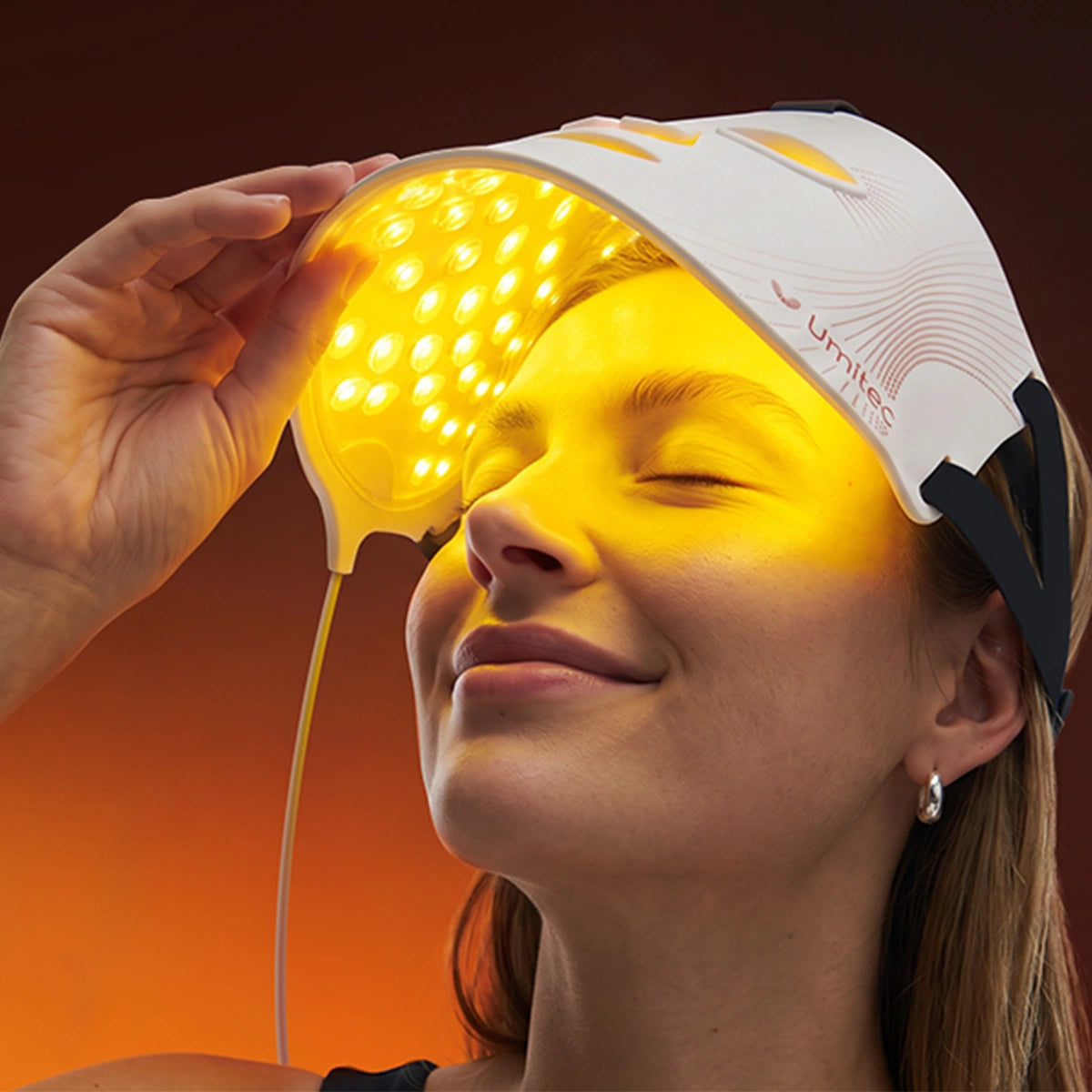
He also mentions the soft silicone and the adjustable straps — how it moulds to the face instead of pressing on it, and that he can wear it while watching TV. That's comfort, not pigment science, but it's the reason a ten-minute session actually happens on a Tuesday instead of being postponed. A routine you'll keep is a routine that stays at ten minutes. The mask he's describing is here.
If you've been running the whole-face version

You don't need to throw the device away. You need to change four things, in this order:
- Stop blue for two to four weeks. Keep red and near-infrared if you want to keep a habit — they're the half of the pair that doesn't drive pigment. Give the skin a stretch with nothing new on it, so you can see what's actually there.
- Photograph before you restart. Same room, same window, same time of day, no makeup. Front and both sides. A phone photo in flat light is more useful than your memory in three weeks.
- Restart blue on one zone, only while a breakout is active. Chin or forehead, ten minutes, with red in the same session. Stop when the breakout settles — that's the off switch, not the calendar.
- Wear tinted SPF by day. Ordinary sunscreen is built for UV; the visible band is absorbed by iron oxides — the pigments that make a sunscreen tinted. If you're pigment-prone, that's the step that protects the work.
And one rule that isn't a step: if a spot you're treating gets darker rather than calmer, stop and see someone. Deepening pigment during treatment is a signal, not a phase. Melasma is the clearest case — with melasma, blue is a no, and that's not a dosing question. The acne-prone playbook covers the rest of the routine.
Why our mask can't quietly become that five-week scenario

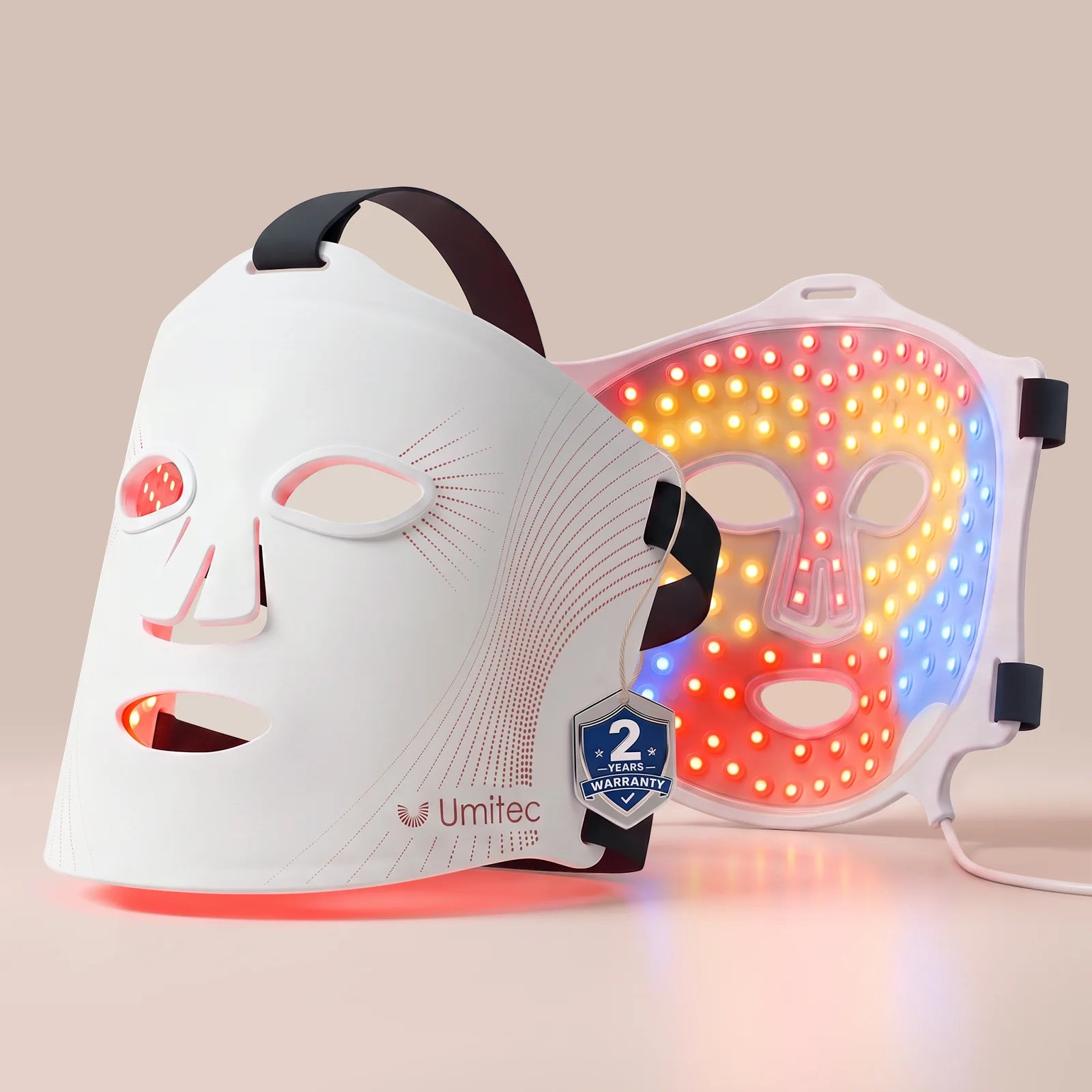
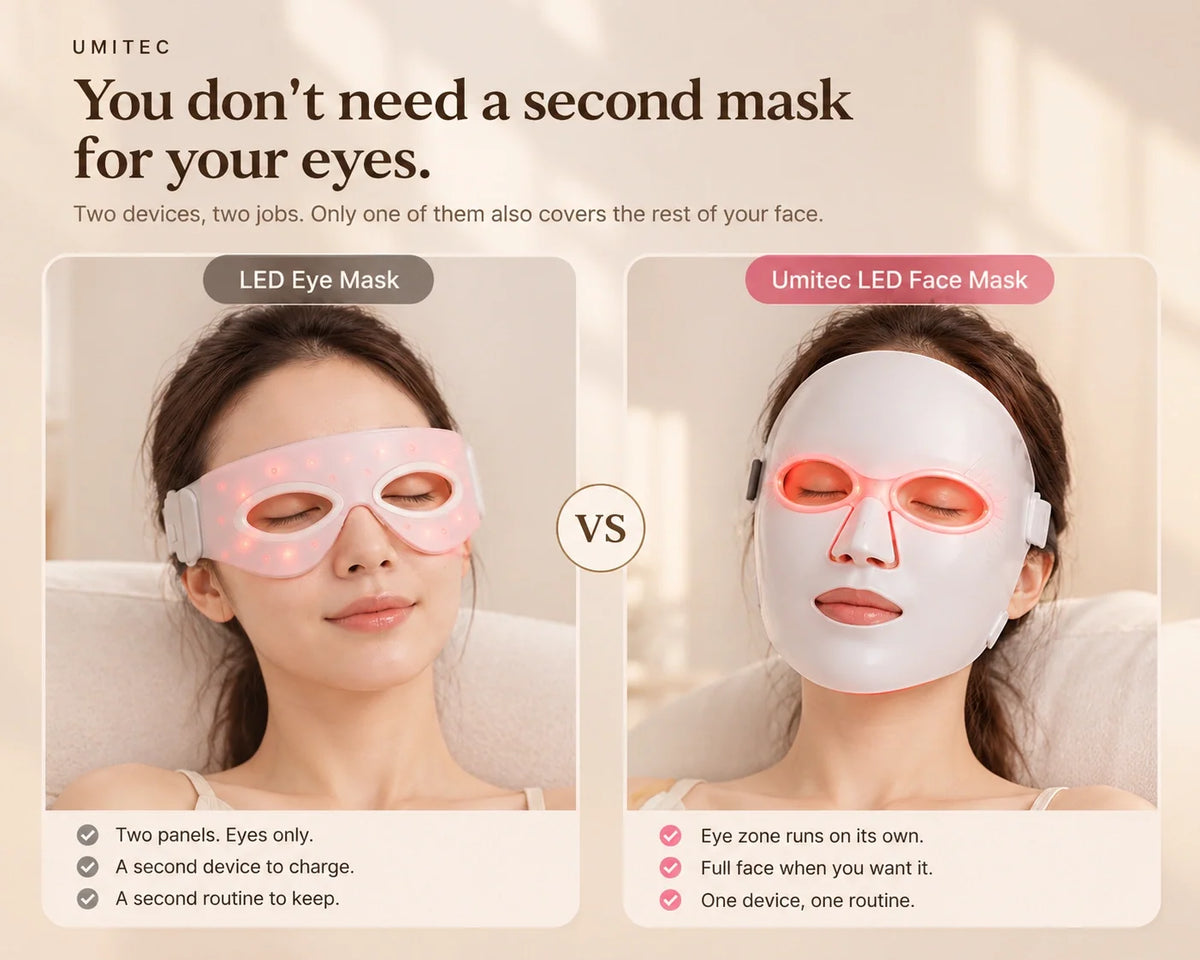
The ZoneCraft™ is four zones on one plate — forehead/T-zone, eye area, cheeks, mouth — and each one switches on independently. You choose the zone, the mode and the intensity on the remote before you put it on. Blue has its own mode, and that's what zones are for: a breakout on the chin is a chin problem — ten minutes, one zone — not a face problem for five weeks. What keeps it from turning into the five-week scenario isn't a lockout — the device will light the whole face in blue if you tell it to. It's that doing so takes four deliberate decisions, one of them every single day, and the instructions spend their time arguing against all four.
Two more limits, both deliberate. The timer is fixed at ten minutes and the intensity has three steps — the honest way to build a pigment-relevant mode is to fix the dose so nobody improvises upward. And we don't sell blue as a brightening or spot-fading treatment, because it isn't one. 415 / 590 / 630 / 830nm across 492 LEDs, FDA-cleared under 510(k) K213056 for its named indications.
That's not a safety badge on top of a risky product. It's the product being built around those three decisions instead of leaving them to you at 11pm.
Quick answers
Will five weeks of whole-face blue light definitely give me pigment? No — "definitely" isn't how pigment works. Skin type, history, existing damage and how much daylight you get all move the result. What the five weeks show is the direction of travel when area, frequency and duration are all maxed out. If you already have pigment, that direction is much steeper.
I've been doing it for a month. What now? Stop blue for two to four weeks, keep red if you want, photograph in flat light, and watch. Most people find the "new" patches were faintly there before. If something genuinely deepens over those weeks, see a dermatologist.
Can blue light fade the spots it caused? No. It's the band most likely to create them, and it has no fading mechanism. Established pigment is a dermatology conversation — topicals, sometimes lasers — not a mask setting.
I have melasma. Can I use the Anti-acne mode at all? No. Keep blue out entirely, even locally. Red and near-infrared may be reasonable if your clinician agrees. This is the one line I'd hold firmly.
Do I need a special sunscreen if I use blue? If you're pigment-prone or using blue regularly, yes — one with iron oxides, which is what tinted sunscreens have. Regular SPF is a UV product; it barely touches 400–450nm.
Is ten minutes a day too much? Ten minutes on one zone, while a breakout is active, with a red pass after it, is the version the evidence supports. Ten minutes on the whole face, every day, forever, is the version on that panel. Same number, different exposure.
The short version
Blue light is a real tool for active breakouts and a real pigment risk, and both facts come from the same photons. What separates them isn't the colour or the brand — it's area, frequency, duration, and whether anything is protecting the skin between sessions.
Five weeks of whole face, every day, blue only, is how you find the risk. One zone, ten minutes, while the breakout is there, is how you get the benefit — the light lands where the problem is, and the rest of your face never takes it. Our mask is built so the second version is the easy one, and the first takes a decision you'd have to make on purpose, every day.
The Umitec ZoneCraft™ LED Face Mask keeps blue on the zone that needs it, asks for a red pass alongside, and fixes the session at ten minutes — four wavelengths (415 / 590 / 630 / 830nm), 492 LEDs, four zones that switch on independently, three intensity steps. FDA-cleared (510(k) K213056). $144.99, rated 4.8 by 145 customers, 2-year warranty, free 5-day US & UK shipping, 30 days to change your mind.
General information, not medical advice. The five-week images are an illustration, not patient records or clinical results. Home LED masks support daily skin management and cleared indications; they don't replace professional care for melasma, stubborn pigmentation, deep scarring or structural concerns. Blue light is not a brightening or spot-fading treatment. Stop use and seek advice if you experience burning that doesn't settle, welts, persistent redness, eye discomfort, or new or deepening pigment. Not recommended if you're pregnant or breastfeeding, taking photosensitising medication, have open wounds or active skin infections, or are under 18 — see our FAQs or ask a dermatologist.

Laisser un commentaire
Ce site est protégé par hCaptcha, et la Politique de confidentialité et les Conditions de service de hCaptcha s’appliquent.