


Five years ago an LED face mask was a clinic thing. Now there are hundreds of them, priced from $25 to $600, all glowing the same three colours and all promising the same glow back. The physics hasn't changed — the packaging has.
So this guide runs backwards: from the most expensive mask on the shelf down to the cheapest thing with a strap. It's the fastest way to see what money actually buys here, because every feature the $600 mask charges for has to reappear — or vanish — as the price falls.
Therabody TheraFace Mask — about $600
The only mask here that does something with its frame as well as its light. Seventeen tiny vibration motors are built into the shell, so a session is a nine-minute facial in three stages rather than a light bath: you feel it working in a way nothing else on this list lets you feel. Cordless, heavy on purpose, and it lives on a charging stand.
What the extra $400 buys: the massage and the name. The vibration is a comfort feature — genuinely nice on a tight jaw, completely irrelevant to how much light reaches your skin — and it only runs one setting for the whole face.
Who it's for: you want the ritual as much as the result, you'll actually use the massage, and $600 is a number you don't need to justify to anyone. If light is the only thing you're after, the same money covers two good masks and a year of serum.
CurrentBody Series 2 and 3 — about $480–570
The one feature nobody else has: a 1072nm channel sitting deeper than the near-infrared everyone else stops at, and on the Series 3, an app that lets you choose which wavelengths fire. Soft silicone, so you can lie down in it and forget it's on.
What you give up: its two workhorse wavelengths — 633 red and 830 near-infrared — are the same ones every mask below this line uses. Per wavelength, you're paying several times over for the extra depth and the app.
Who it's for: you want the top of the range and nothing below it, you enjoy tuning settings in an app, and you'd rather buy once than trade up later.
Dr. Dennis Gross SpectraLite FaceWare Pro — $455
Built entirely around three minutes. This is the mask that made "you don't have to sit for ten minutes" a selling point, and it's still the fastest serious option on the shelf — rigid, red, blue and near-infrared, done before a kettle boils.
What you give up: three minutes is a convenience, not a bigger dose — a short session at an unpublished output is a guess with a timer. It also publishes no output figures at all, so there's nothing to compare it against.
Who it's for: you know yourself well enough to know you will never do ten minutes. Three minutes every night beats a perfect protocol you skip.
Omnilux Contour Face — $395
The most studied mask on this list, and the simplest: two wavelengths, one mode, ten minutes, nothing to choose. Almost every clinical paper this category quotes was run on light like this.
What you give up: choice. No blue for breakouts, no second programme, no eye shields in the box. One concern, one setting — if your skin has two problems, you'll end up owning a second device.
Who it's for: exactly one concern — fine lines and firmness — and you'd rather buy the evidence than the feature list. The least speculative purchase here.
Shark CryoGlow — $299.99
Two things nobody else at this price has. First, because the shell is rigid, the LEDs hold a fixed angle and a fixed distance from your face, so output can run high and stay identical from the first minute to the last — nothing shifts, because you don't. Second, the under-eye plates: three temperature levels of real cooling, genuinely pleasant on a hot evening or a puffy morning, and not a sticker pretending to be a feature.
What you give up: zone control. Every LED fires or none does, so a breakout on your chin gets exactly the same light as clear cheeks. And the shell is about 1.5lb on a cable to a remote — this is a mask you sit down in, not one you wear while folding laundry.
Who it's for: you'll happily sit still for six minutes, your concerns are spread across the whole face rather than parked in one place, and $300 feels acceptable for the cooling. It's a good machine. If you want different light in different areas, it structurally can't do it.
INIA GLOW 4D — $209.99
Cordless, and the only mask here that wraps under the jaw. That extra panel is the feature: most masks stop at the chin, and a jawline that gets no light for two years starts to show it. Four programmes, blue and red both on board, plus a second near-infrared channel at 940nm.
What you give up: the battery lives inside the mask. That's why it's wireless — and why it doesn't sit quite straight: the weight is on your face, so it creeps forward as you move and you end up pulling the straps tighter to keep it level. That's where the pressure complaints come from, and on a wider or higher nose bridge it reads as a headache. Sessions also run five to twenty minutes, the longest on this list.
Who it's for: wireless matters because you'll never stand in one spot for it, jaw and chin coverage matters, and you don't mind carrying that weight on your face for ten minutes.
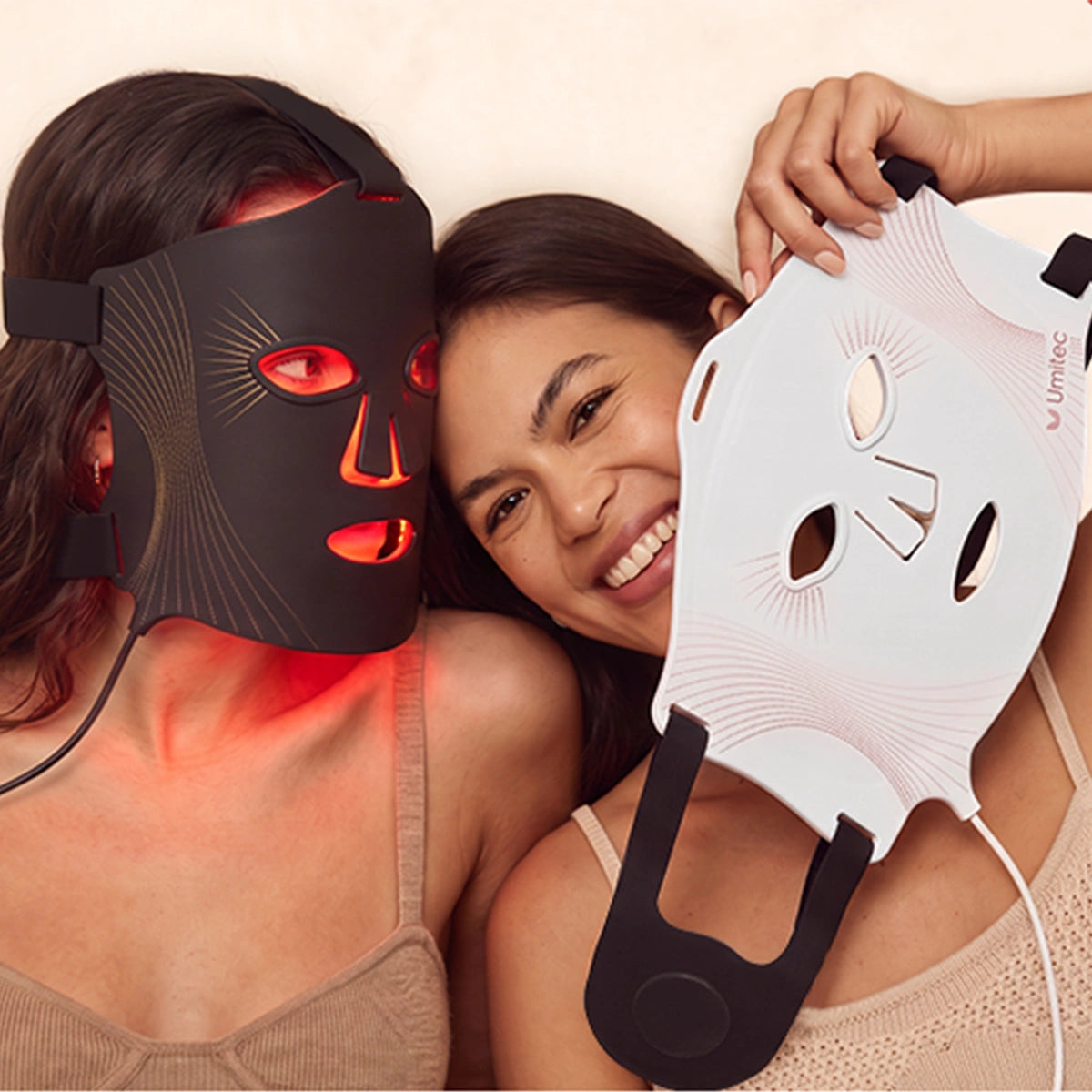
Umitec ZoneCraft Series 3 — $144.99
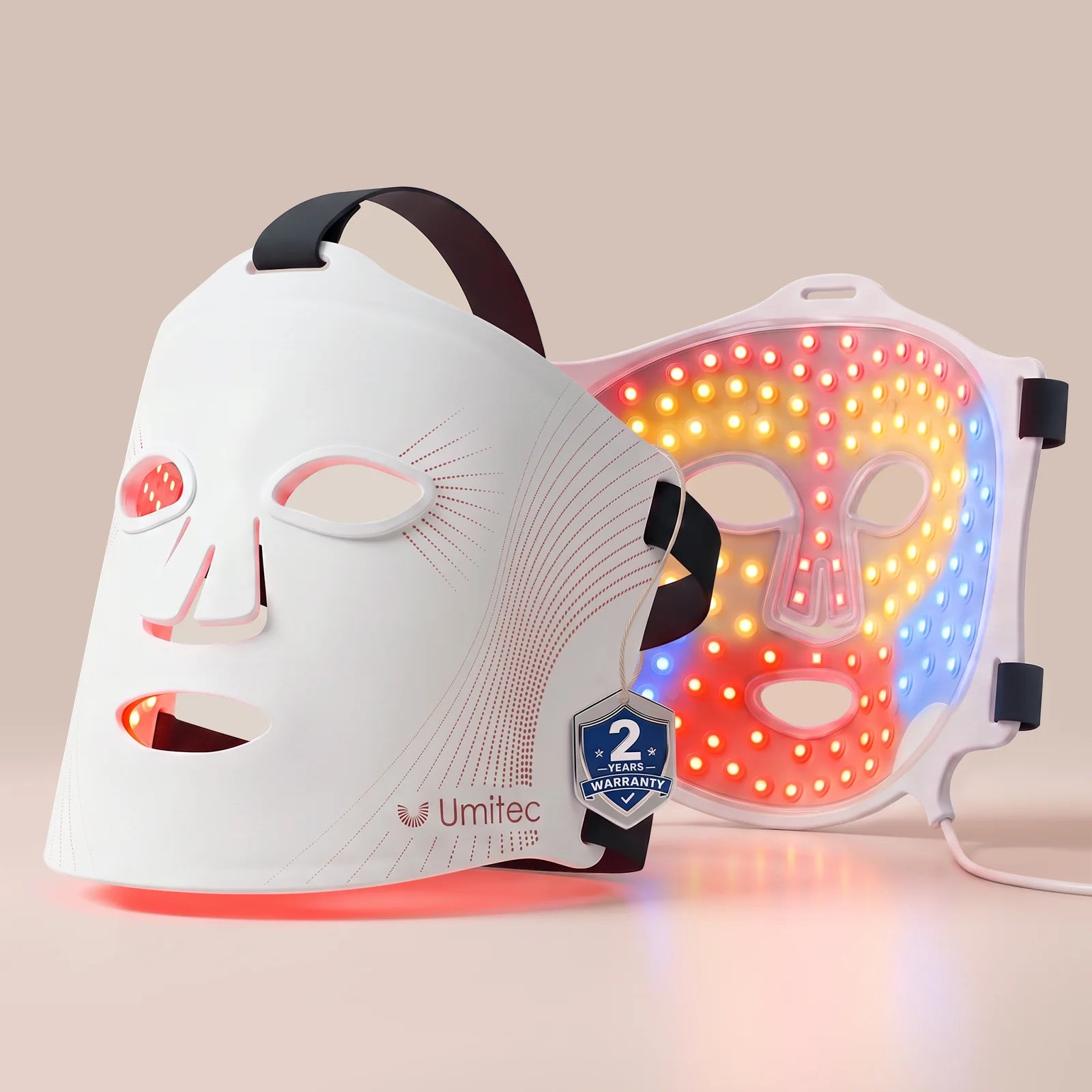
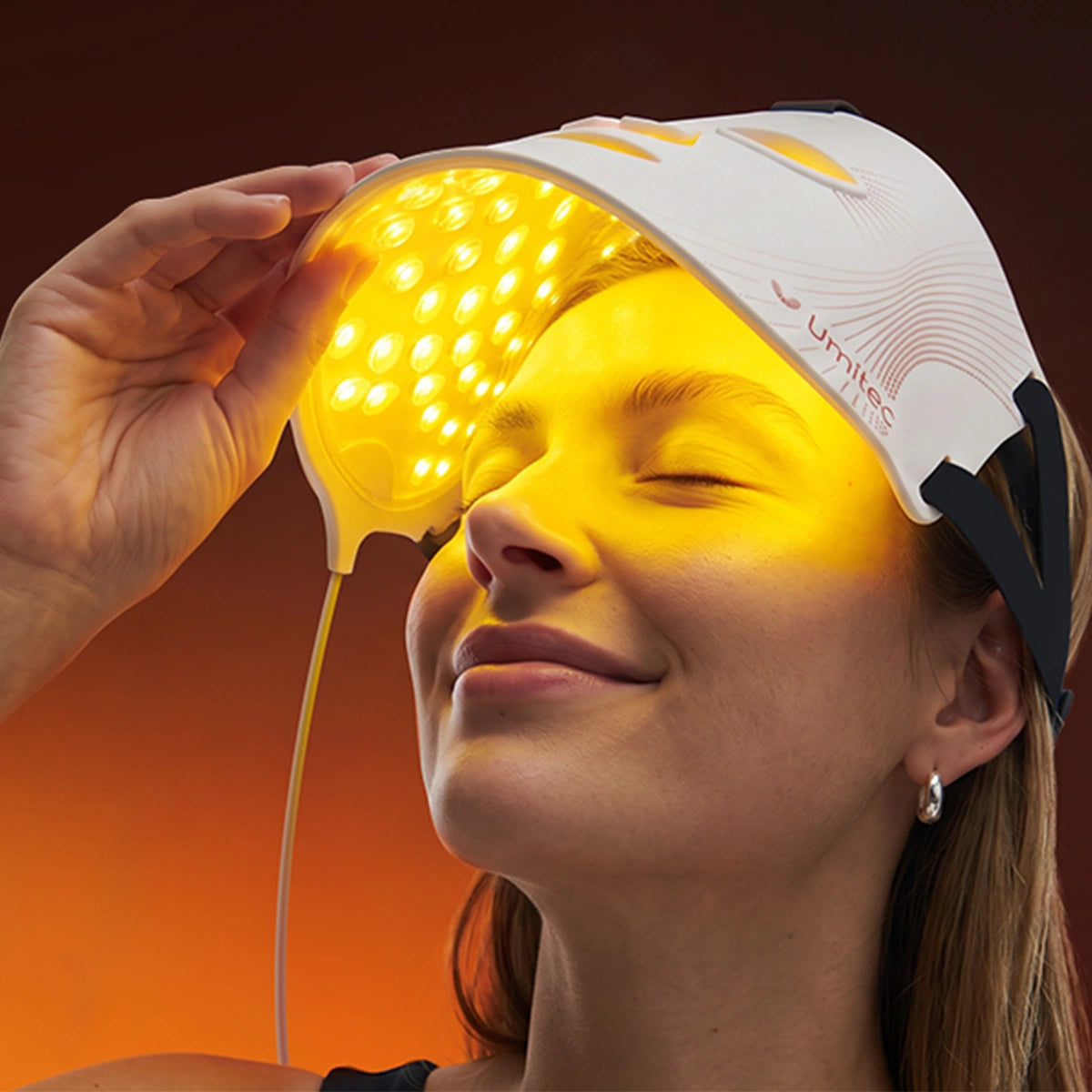
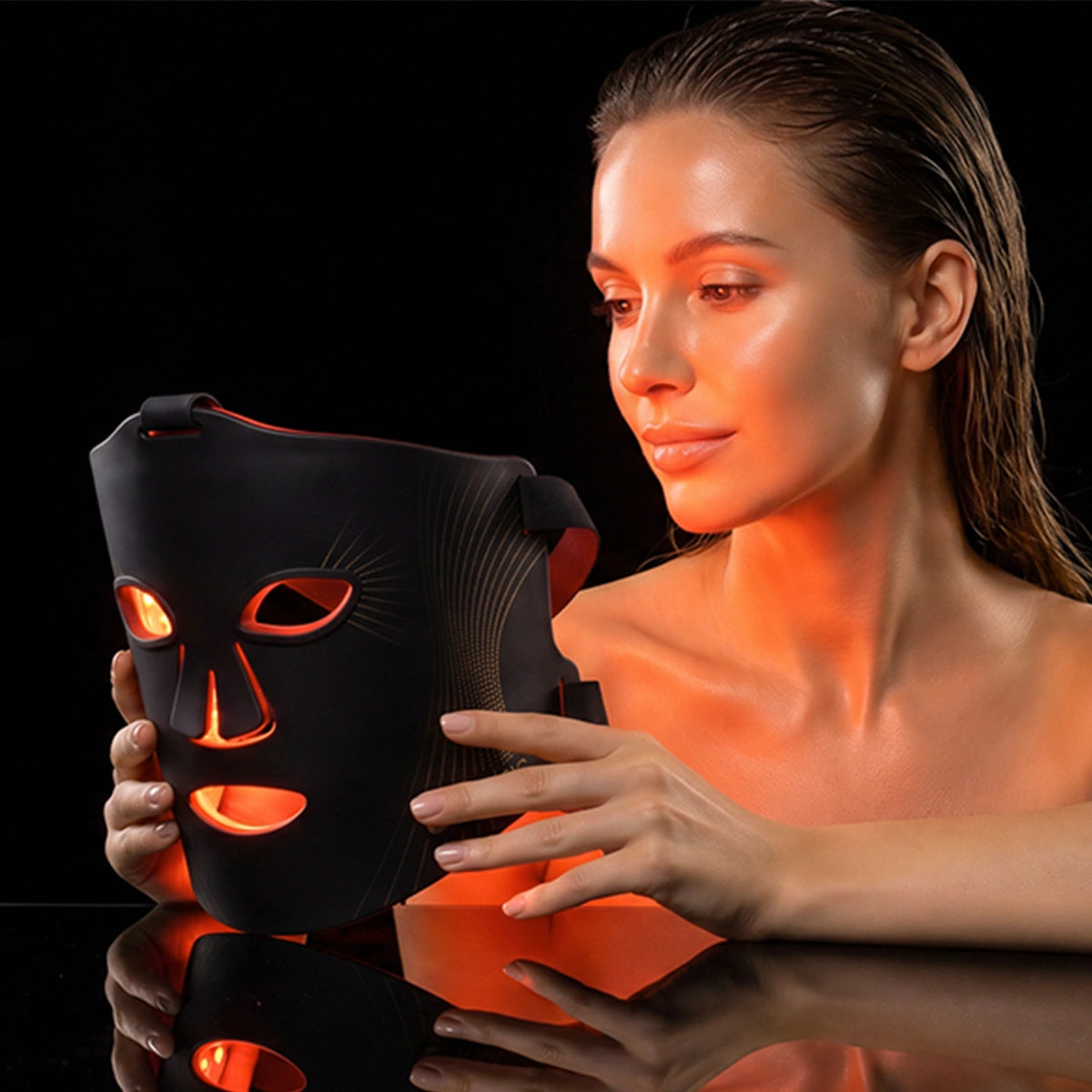
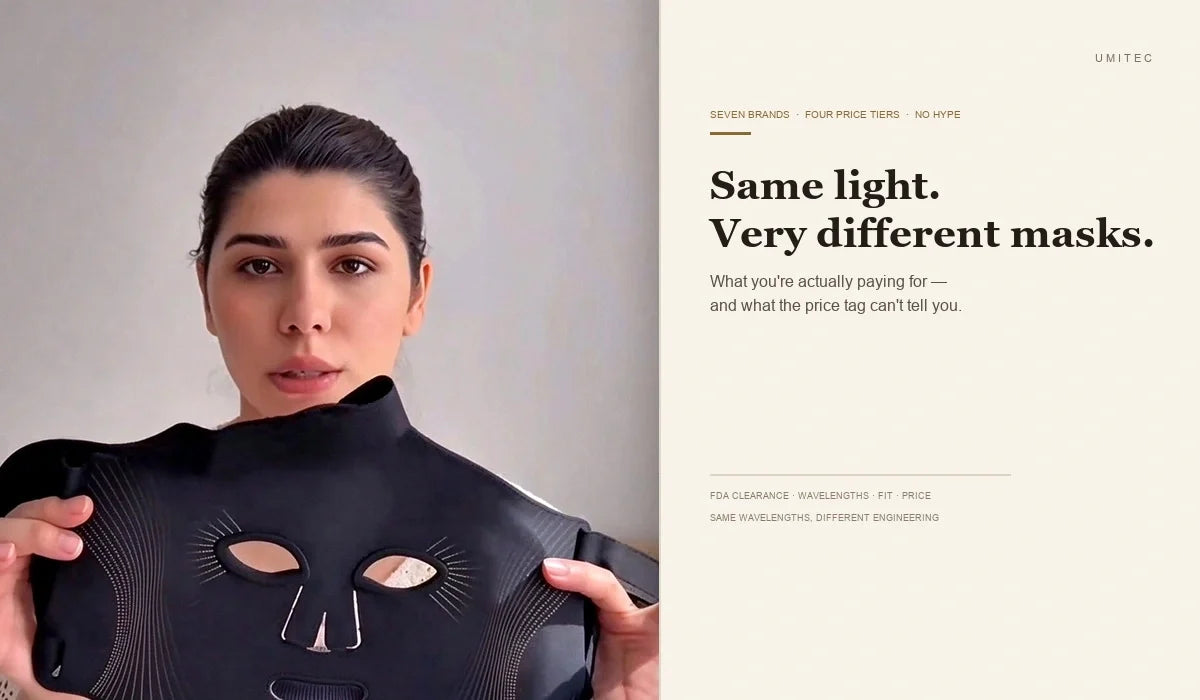
Where the price curve turns interesting again. The ZoneCraft™ Series 3 is $144.99 (listed from $199.99) and it carries the one thing missing from every mask above it: four independently switchable zones — T-zone, eye area, cheeks, mouth and chin. Blue on a chin that's breaking out while the cheeks take red. Yellow over a reactive patch with everything else dark. Four wavelengths, four modes and three intensity levels to drive it, and flexible enough to sit flush against the skin and pack flat.
Zone control is normally clinic-bed equipment, not something you buy for the price of a serum set. That's the whole case for this mask, and it's a real one.
Who it's for: a face that isn't one problem in one place — a chin that breaks out, cheeks that don't, an eye area that wants less of everything. Which is most faces. Ask yourself which single mask above matches your skin exactly; if the answer is none, or two, this is the one that stops you having to choose.
Four zones, four wavelengths, $144.99 → see the ZoneCraft™ LED Face Mask
Unbranded marketplace masks — $20–30
Search any marketplace and you'll find hundreds in this range, all promising clinical grade and "the same as the $500 brands". Here's what's usually missing from the listing:
No nanometres, no mW/cm² → nothing you can check.
Big numbers, no units → a count of emitters tells you nothing about dose.
No eye protection → the one part of this category where "probably fine" isn't good enough.
The risk isn't that a $25 mask burns you — it's that it may sit below the output where anything therapeutic happens, so you pay for the ritual and the red glow. This is the one tier where the honest advice is to keep your money: sunscreen and a retinoid will do more this year, and there's a fuller take on whether an LED mask is worth it at all that doesn't pretend the answer is always yes.
The short version
$600, want the full ritual → Therabody TheraFace. You're buying the massage and the badge.
$480+, want the deepest channel → CurrentBody Series 3.
$455, won't sit for ten minutes → Dr. Dennis Gross SpectraLite. Three minutes you'll finish.
$395, one concern, longest evidence → Omnilux Contour.
$300, will sit still, whole-face concerns → Shark CryoGlow. The cooling earns it.
$210, wireless with jaw coverage → INIA GLOW 4D.The battery rides on your face.
$145, your face isn't one problem → Umitec ZoneCraft Series 3. The broadest fit on this list.
$25–30 → buy sunscreen instead. You'll get more.
Questions people ask anyway
Is a hard shell better than silicone?
Neither. A shell holds its distance and can carry cooling and a bigger battery, but you stay still. Silicone touches your skin and moves with you, but can't hold the same hardware. Match the trade to how you behave at 10pm.
Are the cheap ones dangerous?
Usually not dangerous — unverifiable. The risks that do exist are eye-related and come from missing shielding. If a listing states no wavelengths, no output and no eye protection, you can't judge what you're putting on your face.
One mask for acne and pigmentation?
Carefully. Blue 415nm is for mild-to-moderate inflammatory acne and works best with red, not alone. With melasma or a history of stubborn dark patches, blue is the wavelength to be cautious with, and a diagnosis comes before any device — this guide to acne marks versus melasma explains why.
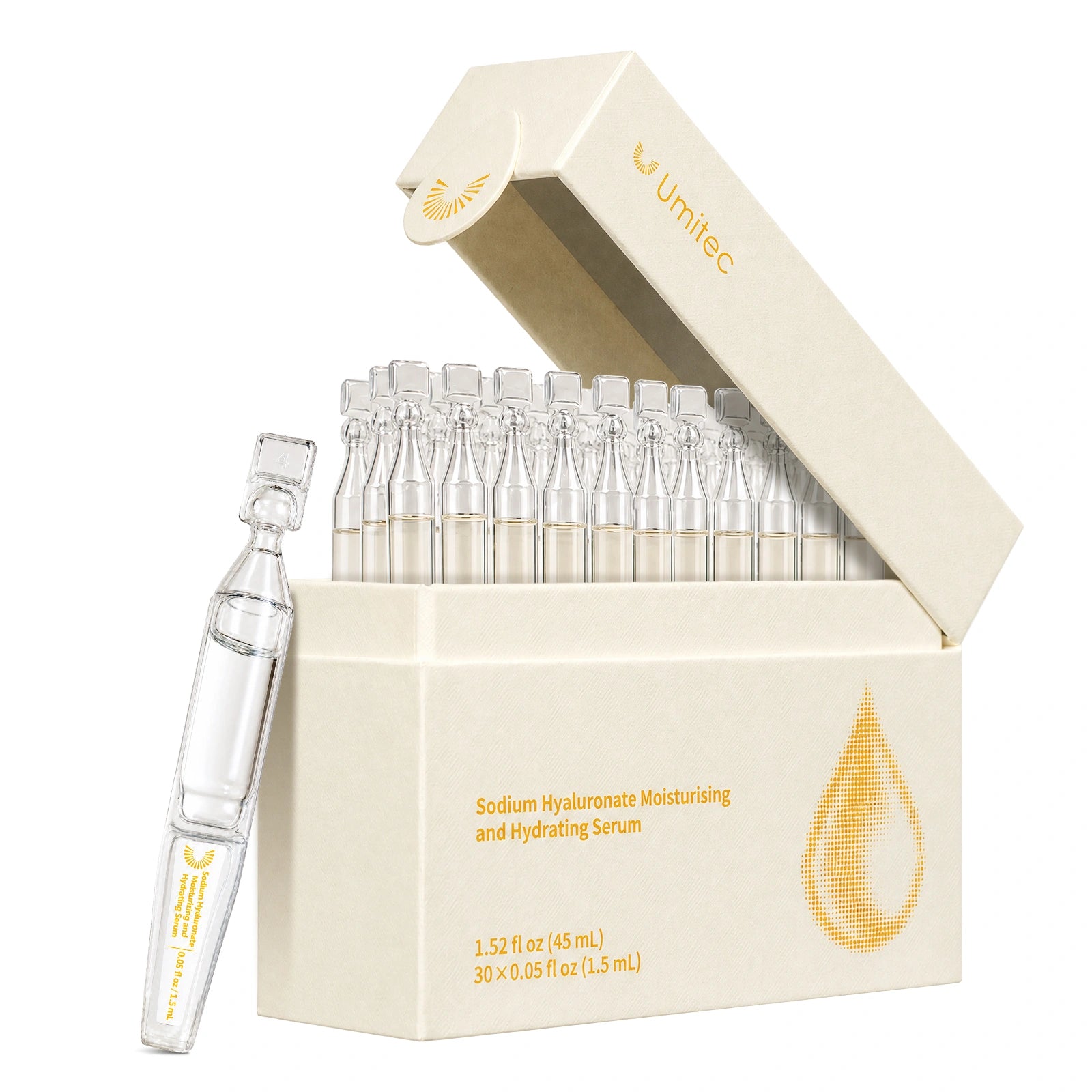
If zone control is what your face has been asking for, the ZoneCraft™ is $144.99 — or take the mask and its after-care together in the exclusive bundles.
Specs and prices were taken from each brand's public product pages in November 2026 and may change. The other brands named here have no relationship with this site and did not review this article. Nothing here is medical advice — if you're pregnant or breastfeeding, taking photosensitising medication, have melasma, an active skin infection or a history of eye disease, ask a clinician first. Study detail lives on the clinical testing page and in the FAQs.

Laisser un commentaire
Ce site est protégé par hCaptcha, et la Politique de confidentialité et les Conditions de service de hCaptcha s’appliquent.