



If your skin is medium-to-deep and you've heard that blue light can darken it, you're asking exactly the right question before you spend a dollar. It's the question we hear most from customers with deeper skin — and it deserves a real answer, not a shrug and a "just be careful."
So here it is, up front: yes, blue light can trigger pigment. But the risk isn't really about the color — it's about the dose. How much light, over how much of your face, for how long. Those are the three dials, and a well-designed mask keeps all three where they belong. That's the difference between a wavelength to fear and one you can actually use.
And no — your phone is not why your skin darkened. A screen is hundreds of times too weak to do that. The light that matters is the light you deliberately put on your face: the sun, and a treatment mask. Which is exactly why the mask you choose matters so much.
Short answer: blue light can cause or deepen pigmentation, and medium-to-deep skin is more prone to it. But the risk is shaped by dose — and dose is something a good mask controls for you. If you have melasma or active dark spots, skip blue entirely. If you have acne, blue can still work: locally, briefly, paired with red, after a patch test, with tinted SPF by day.
The 30-second answer
Blue-violet is the pigment band. Of all visible light, the 400–450nm slice drives the most melanin — and 415nm sits right inside it.
Deeper skin answers more. Medium-to-deep skin can develop stronger, longer-lasting pigment from the same dose. That's a reason to control the dose — not to avoid light forever.
Dose decides everything. A phone screen is hundreds of times weaker than midday sun. A treatment mask is not. So it's the mask, not your laptop, that deserves care.
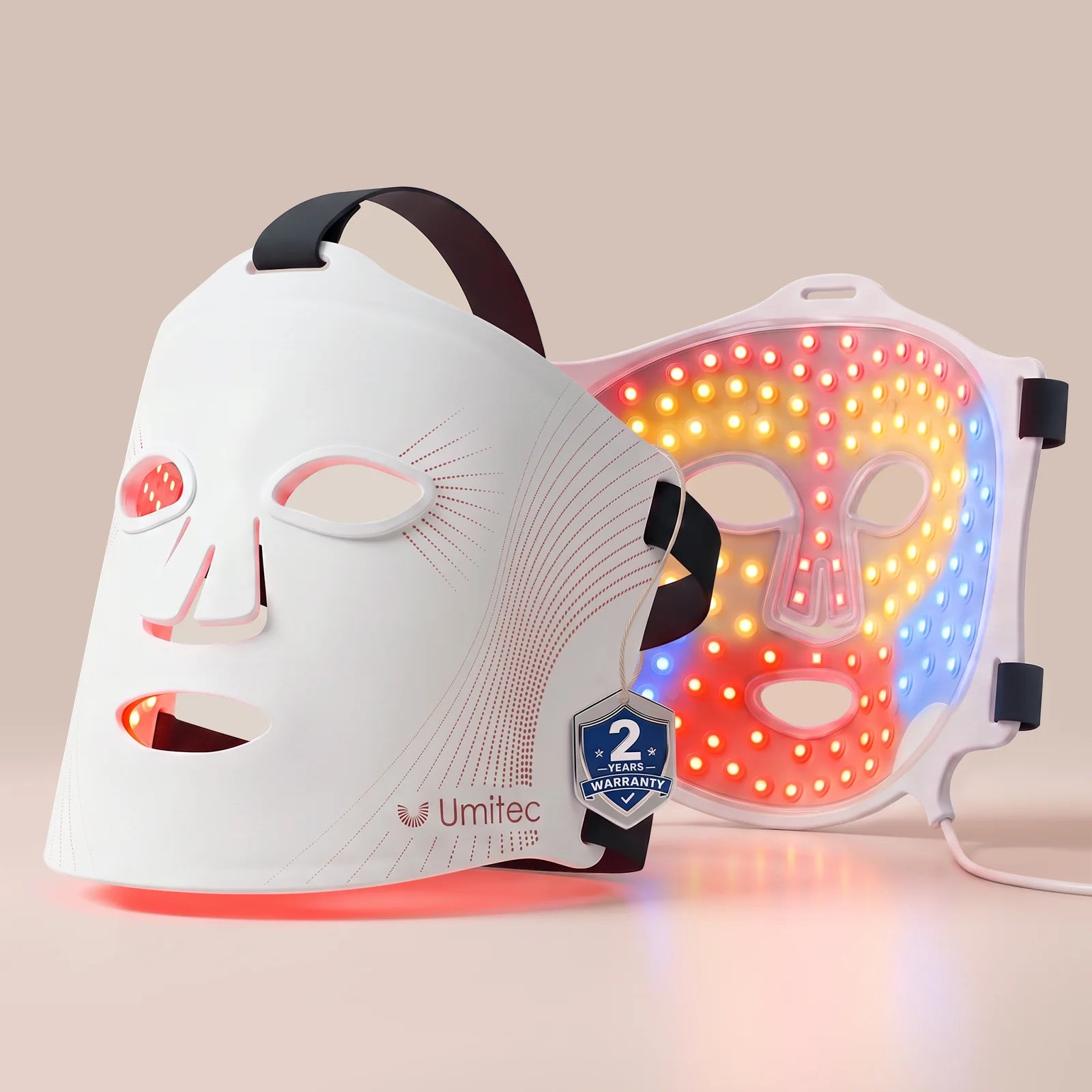
The mask this guide is about: Umitec ZoneCraft™ LED Face Mask — four wavelengths, blue kept local and paired with red. $144.99 →
The worry is real — and the risk is manageable
Let's not pretend otherwise. Blue light at 415nm is genuinely the most pigment-active part of the visible spectrum. In controlled studies, blue-violet light left pigment that outlasted a UV tan, while red light at 630nm left none. That's not a marketing caveat — it's the reason this article exists.
But here's the part the scary headlines skip: those studies delivered a dose. Pigmentation isn't switched on by a color; it's switched on by enough light reaching the cells that make melanin. Change the dose, the location and the duration, and you change the outcome. You don't have to become a dermatologist to use blue safely — you need three dials, and a device that has already set them sensibly.

The color isn't the risk. The dose is.
So what actually causes it? (Hint: not your phone.)
This is where a lot of internet advice loses the plot. Yes, screens emit blue light. No, your laptop isn't giving you melasma. Direct midday sun delivers roughly 30–60 mW/cm² of visible light to your skin; a phone at reading distance delivers a tiny fraction of one. That's a gap of hundreds to a thousand times.
The studies that produced pigmentation used doses you'd reach in minutes of direct sun, or from a device held close at real power — not from a screen. The light worth managing is the sun (including the visible part ordinary SPF barely touches) and a treatment mask. Your phone is a rounding error.

That's good news: you don't have to fear your screen. It's also the reason we built our blue the way we did.
The one group who should skip blue entirely
If you have melasma, stubborn pigmentation, or active dark spots — or you've recently had a laser, a peel, or anything that left your skin in recovery — blue is the wavelength to leave alone. Not "use less." Leave it. This isn't us being cautious to cover ourselves; it's the same guidance in our own clinical knowledge base: for melasma, blue light is the one to be cautious about.
Red and near-infrared are the safer half of the pair for deeper skin. In controlled work, 630nm red produced no pigmentation, and it supports repair rather than driving melanin. It won't fade established pigment either — nothing you wear on your face does — but it's the part of the routine you can keep. If you're not sure whether you're looking at a scar, a red mark, or true pigment, start with acne scars vs post-inflammatory hyperpigmentation.

If you have acne, use blue like this
The advice isn't "never." It's "use it the way the evidence supports" — narrow, short, paired, tested, protected. These five rules are the whole method, and they sit inside the fuller acne-prone playbook.

Two deserve more than a line. The patch test isn't a formality — blue reactions can be delayed, so give it 24–48 hours on the jawline before a full session. And "protect by day" means something specific: ordinary sunscreen is built for UV, not the visible band. Iron oxides — the pigments that make a tinted sunscreen tinted — are what actually absorb 400–450nm. For pigment-prone skin, that's the difference between defending the band and defending the label.
One more rule that's a stop, not a step: if a spot you're treating gets darker rather than calmer, pause. Darkening during treatment is a signal. Breakouts and reactions after blue light walks through what may be happening.

Why our mask is built for exactly this
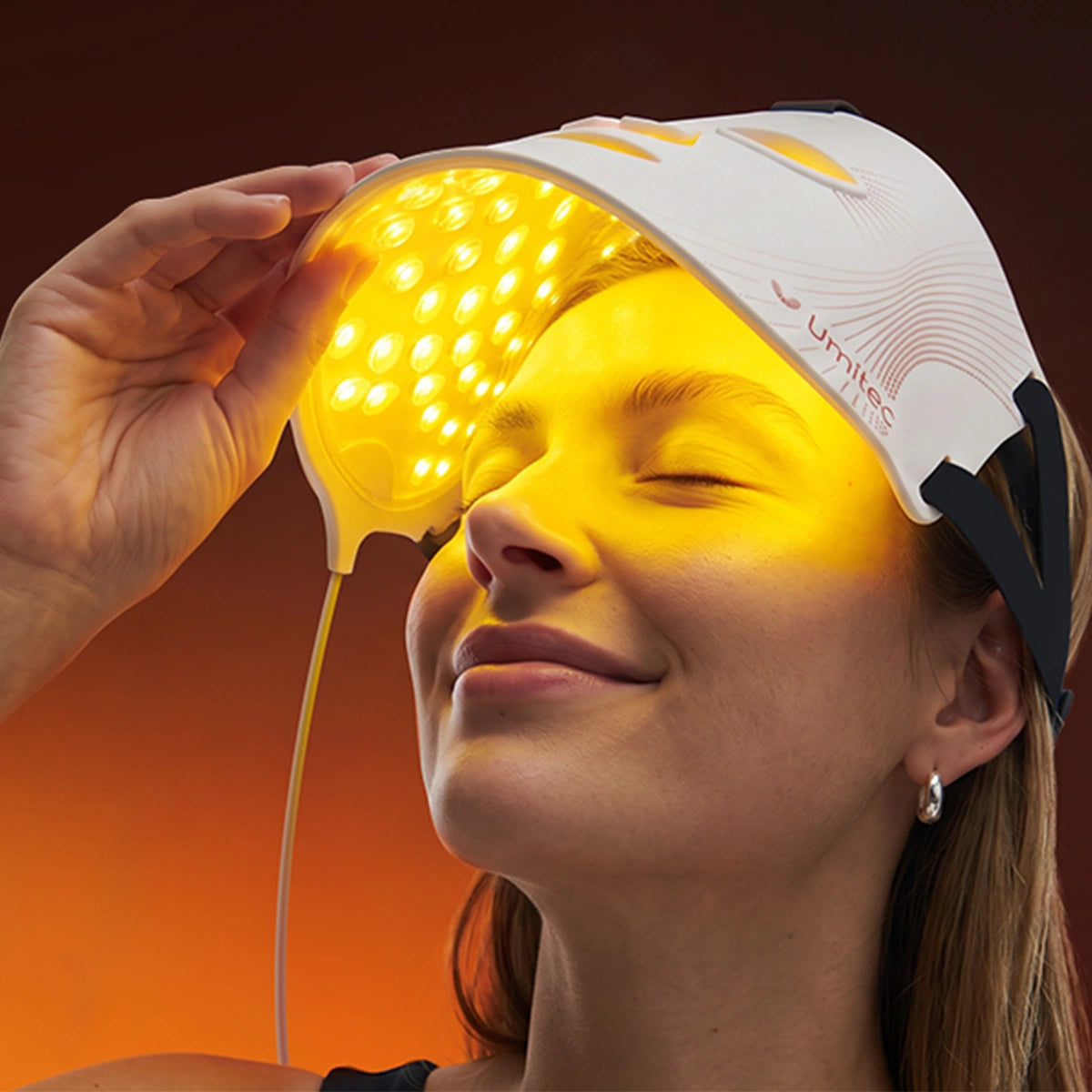
Here's the part that matters if you're deciding whether to buy. We didn't build a mask that asks you to be careful and then hands you a full-face blue wash. The blue lives inside the Anti-acne mode, paired with red, and it's meant for the zone where you're actually breaking out — not the whole face. 415 / 590 / 630 / 830nm across 492 LEDs, four concern-matched modes, a 10-minute timer, three intensity levels.

The timer and intensity steps aren't decoration. Pigment risk scales with dose, so the honest way to build a blue mode is to fix the dose and stop you improvising upward. That's also why we don't tell you to extend sessions or stack every mode — more exposure isn't more result. Ours is FDA-cleared under 510(k) K213056 for its named indications; "cleared" means the intended use is covered, not that it treats pigment disorders.
And the one thing we won't do is sell blue as a brightening or spot-fading treatment. It isn't. If pigment is your main concern, blue is the mode to skip — and a dermatologist is the person to see. For the zone-by-zone version of that logic, the mode protocol guide covers it.
What actually changes — and what doesn't
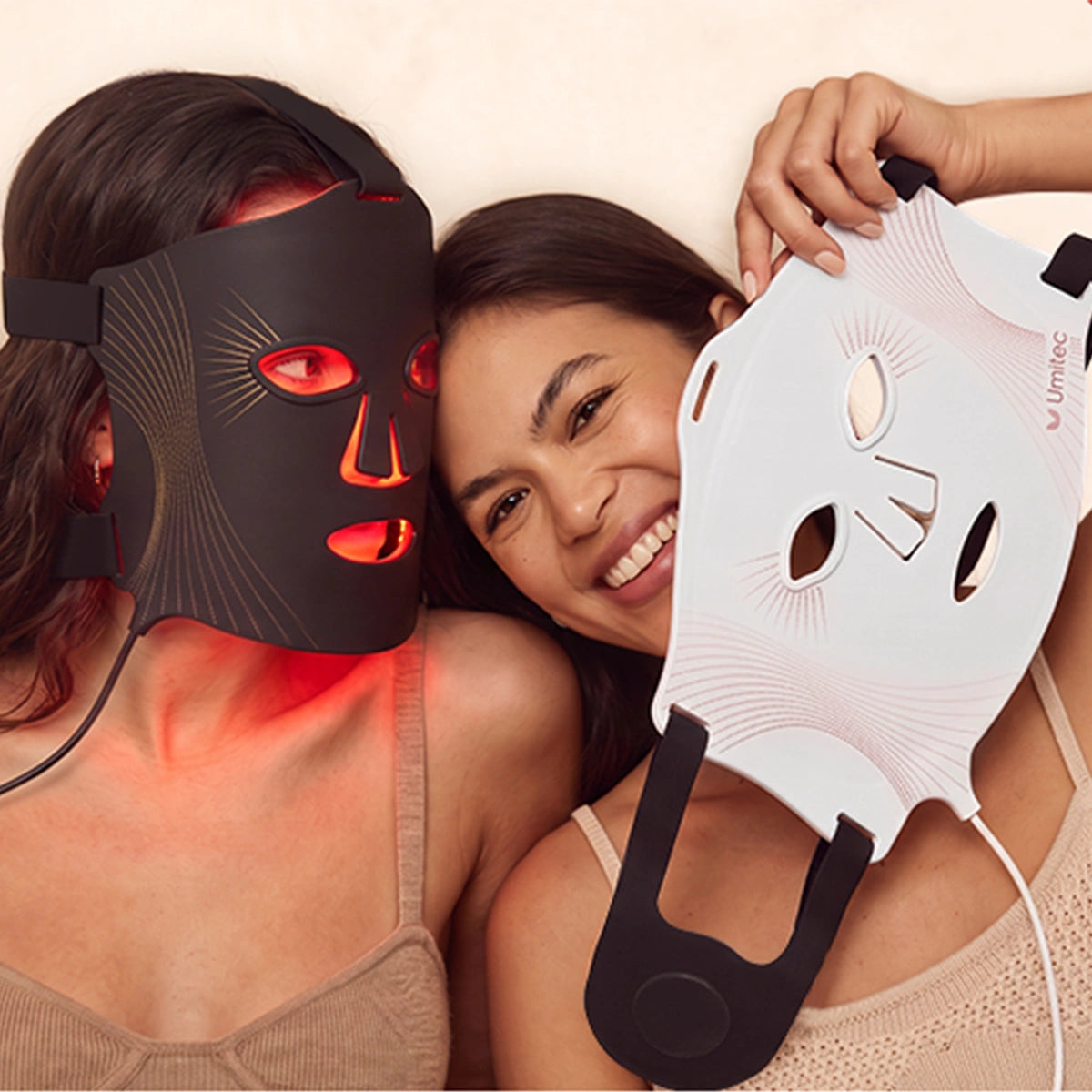
Across 145 reviews the mask holds a 4.8. What customers describe is what cleared indications predict: breakouts that look calmer, skin that looks fresher, softer lines around the eyes. What it does not do is erase pigment — and no home device honestly will. That's why you won't find a dramatic before-and-after here. Real routines look like this: ten minutes folded into a morning, a work break, or the end of the day. If you're still weighing whether a home mask earns its place at all, is an LED mask worth it walks through the trade-offs.

Why you can buy with confidence
- It's cleared for what it claims. FDA 510(k) K213056 covers its named indications — this isn't a generic "wellness" gadget.
- The blue is already controlled. Zoned, paired with red, a fixed 10-minute timer and three intensity steps — so the dose stays where it should.
- If it isn't right for your skin, you're covered. 30 days to change your mind, a 2-year warranty, and free 5-day US & UK shipping.
Quick answers
Will one session give me dark spots? Unlikely on its own, and it depends on your skin, your history and the dose. But pigment is cumulative. One session is a small dose; daily full-face sessions over months are a different exposure. That's why the rules are about pattern, not panic.
Is screen blue light damaging my skin? Not at any realistic screen dose. Midday sun is hundreds to a thousand times stronger. If visible light worries you, the sun and a tinted SPF matter far more than your laptop.
Can blue light fade my dark spots? No. It's the band most likely to create them. Fading established pigment is a dermatology job — prescription topicals, and in some cases lasers — not a mask setting.
I have melasma. Can I use the Anti-acne mode? No. Keep blue out of the routine entirely. Red and near-infrared may be reasonable if your clinician agrees, but melasma is the clearest "do not" here.
Is red light safer for darker skin? In pigment terms, yes. 630nm red produced no pigmentation in controlled studies and doesn't drive the blue pathway the way blue does. It's also why blue is paired with it.
Which skin types does this apply to? Fitzpatrick III–VI, with the strongest caution at IV–VI. The skin-type breakdown explains where you likely sit and what changes.
The honest summary
Blue light is a real acne tool and a real pigment risk, and both facts come from the same photons. For medium-to-deep skin the risk is real but manageable: control the dose, keep it local, pair it with red, test first, protect by day. If you have melasma or active dark spots, skip blue entirely. If you have acne, you can use it — and our mask is built to make that the safe default, not an exception.
That's not a compromise between safety and results. It's the only version of blue light that's worth using on skin like yours.
The Umitec ZoneCraft™ LED Face Mask is built on that principle: four wavelengths (415 / 590 / 630 / 830nm), 492 LEDs, four concern-matched modes, a 10-minute timer and three intensity levels — with blue kept local to the Anti-acne zone and paired with red. FDA-cleared (510(k) K213056). $144.99 (from $199.99), rated 4.8 by 145 customers, 2-year warranty, free 5-day US & UK shipping, 30 days to change your mind.
General information, not medical advice. Home LED masks support daily skin management and cleared indications; they don't replace professional care for melasma, stubborn pigmentation, deep scarring or structural concerns. Blue light is not a brightening or spot-fading treatment. Stop use and seek advice if you experience burning that doesn't settle, welts, persistent redness, eye discomfort, or new or deepening pigment. Not recommended if you're pregnant or breastfeeding, taking photosensitising medication, have open wounds or active skin infections, or are under 18 — see our FAQs or ask a dermatologist.

Laisser un commentaire
Ce site est protégé par hCaptcha, et la Politique de confidentialité et les Conditions de service de hCaptcha s’appliquent.